
Middle Tennessee crawl spaces stay wet because three local conditions stack on top of each other: clay-heavy soil over limestone that holds water against foundations instead of draining it away, summer dew points that sit in the high 60s and low 70s for months, and a housing stock full of vented crawl spaces that pull that humid air in by design. Any one of those is manageable. Together they keep a crawl space damp all summer no matter how dry the dirt looks.

1. The ground here does not drain
Much of Rutherford, Williamson, Wilson, Davidson and the surrounding counties sits on clay-rich soil over limestone bedrock. Clay has very low permeability. When it rains, water does not soak down and away. It sits, spreads laterally, and works its way toward whatever is below grade, which is usually your footing and your crawl space.
Two consequences follow. First, water arrives at the foundation after storms and takes days to leave. Second, even when nothing is visibly wet, saturated clay releases vapor into the crawl space continuously. That is why crawl spaces here are damp weeks after the last rain.
The limestone underneath adds its own behavior. In karst terrain water moves through fractures and channels rather than evenly through soil, which is why one house on a street can have a wet crawl space and its neighbor can be dry.
2. Our summers are humid for a long time
From roughly June into September, outdoor dew points across Middle Tennessee regularly sit in the high 60s and low 70s. Dew point, not relative humidity, is the number that matters here, because it tells you the temperature at which that air will give up its water.
A crawl space is shaded, in contact with the earth, and typically the coolest part of the house. When outside air at a 72 degree dew point moves across a duct or a joist at 68 degrees, water forms. Not sometimes. Every time.

3. The vents were designed for a different climate
Foundation vents assume outside air is drier than crawl space air, so exchanging the two dries things out. That assumption fails here for most of the summer. What the vents actually deliver in July is a steady supply of moisture-loaded air into the coolest cavity in the building.
This is why the worst condensation, the heaviest rust and the first mold in a Middle Tennessee crawl space are so often found near the vents themselves.
4. Grading that has shifted over decades
Most homes were graded to shed water away from the foundation when they were built. Thirty years of settling, landscaping, added patios, mulch beds built up against the block, downspouts that discharge two feet from the wall, and gutters that overflow have quietly reversed that on a lot of properties. It is one of the most common and cheapest things we find.
5. Crawl spaces that were never finished properly
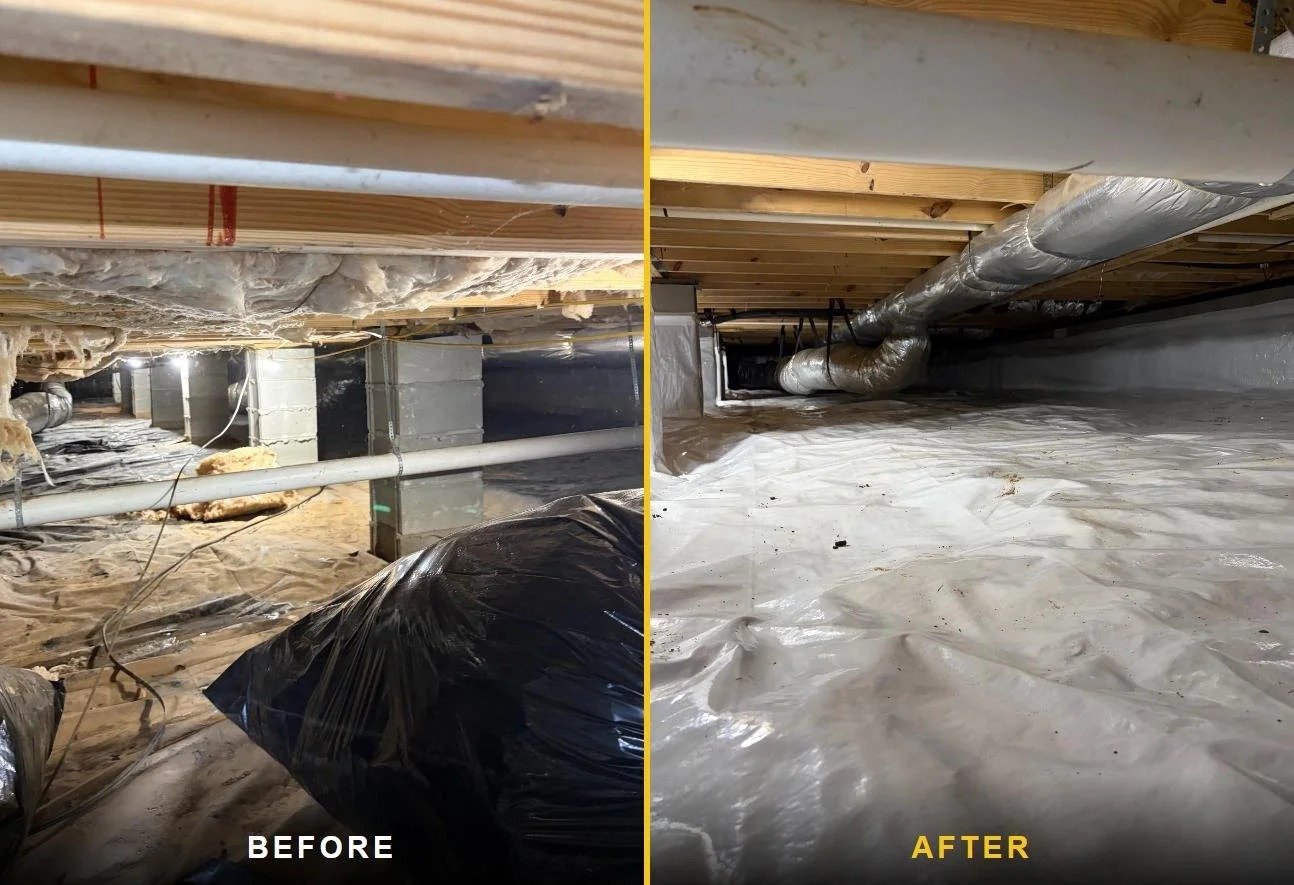
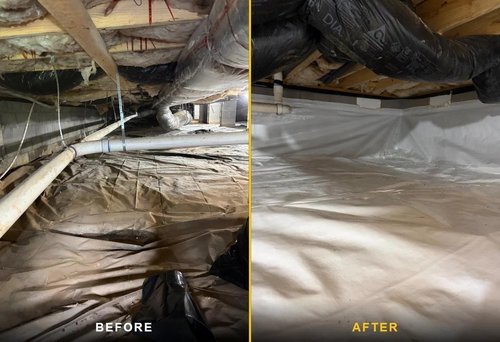
A great deal of the housing stock here predates any serious attention to crawl space moisture. What we typically find is bare dirt, or thin builder poly laid loose across part of the floor twenty or thirty years ago and now torn, buried and useless. Fiberglass batts stapled between the joists absorb moisture, gain weight and fall, and once they are on the ground they hold water against the soil.
What that combination produces
| Condition | What it does to the crawl space |
|---|---|
| Clay soil | Holds water at the foundation and releases vapor continuously |
| Karst limestone | Moves water unpredictably, so problems are house-specific |
| Summer dew points in the 70s | Condensation on every cool surface under the house |
| Open foundation vents | Delivers that humid air directly into the coolest space in the building |
| Negative grade and short downspouts | Liquid water arriving after every storm |
| Torn or missing barrier | Nothing separating the air from the wet ground |
What actually fixes it
You have to address each input, in order, or the fix does not hold.
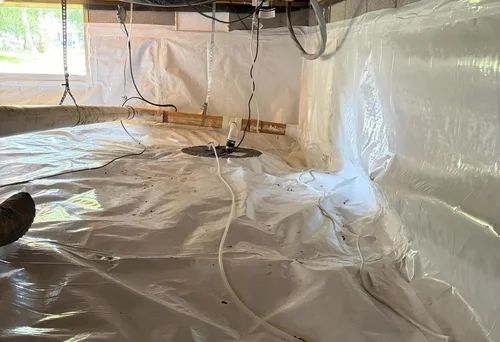
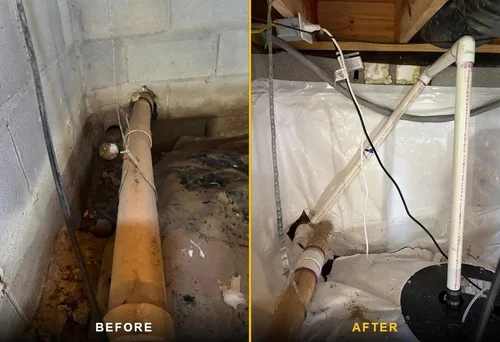
- Get the liquid water out first. Regrade where you can, extend downspouts, and where water still arrives, install interior drainage and a sump pump so it has a path out.
- Separate the air from the ground. A continuous vapor barrier across the floor and up the walls, seams sealed, piers wrapped.
- Stop the humid air. Seal the foundation vents once the ground is covered.
- Remove what is left. A dehumidifier sized for the space, draining continuously.
Done in that order it is a full encapsulation, and it holds. Done out of order, it does not.
Where we see it most
We work across Middle Tennessee, and the pattern is regional rather than town-specific. It shows up in Murfreesboro, Smyrna, La Vergne, Lebanon, Mt. Juliet, Franklin, Spring Hill, Gallatin, Hendersonville and out to Cookeville and Tullahoma. Older neighborhoods with mature trees and settled grading tend to be worse than new construction, and low lots are worse than high ones.

How to tell which kind of water you have
Water under a house arrives from one of three places: surface water running toward the foundation, groundwater rising up through the soil, or a plumbing leak. They look much the same once they are down there, but they need different fixes. Three checks will usually tell you which one you are dealing with.
Does it show up after rain?
Water that appears within a day of heavy rain and slowly disappears over the following week is surface or ground water. Water sitting there in a dry August, with no rain for two weeks, points at plumbing first.
Is it clean or dirty?
Groundwater and surface runoff carry silt, so the water looks muddy and you will see a sediment line on the piers or on the old plastic. A supply-line leak runs clear. A drain or sewer leak announces itself by smell.
Where is it worst?
Water pooling along one exterior wall usually means surface water entering from that side — a downspout discharging at the foundation, or a yard that slopes toward the house instead of away from it. Water spread evenly through the low spots in the middle is groundwater coming up through the soil.
This matters because the fixes are not equally involved. Extended downspouts and regrading are far less work than an interior drainage system, and on some houses that genuinely is all it takes. Sealing a crawl space before settling this question just traps the water under the liner.
Where the water actually gets in
Knowing the crawl space is wet is not the same as knowing where the water arrives, and the answer changes what it costs to fix. Three entry points cover almost every house we go under in Rutherford County.
The access door. On a lot of Middle Tennessee homes the crawl space door sits in a below-grade well, and that well is the lowest point on that side of the house. Rain runs down the wall, fills the well and walks straight in under the door. It is the most common single source we find, and it is also the cheapest to stop, with drainage at the access well that gives the water somewhere to go before it reaches the opening.
Downspouts and grading. A downspout dumping at the foundation puts hundreds of gallons into the soil beside your footing during one storm. Extending it away from the house is often the first thing we tell people to do, and sometimes it is the only thing they need.
Groundwater through saturated clay. This is the one that needs real work. When the clay around the footing stays saturated, water moves through the block and comes up through the floor no matter what you do at the surface, and the fix is a gravel and pipe drain that intercepts it before it reaches the crawl space, tied into a sump.
Want to know which of these is happening at your house? Free inspection, photos, humidity reading, and a written estimate before we leave.
Frequently asked questions
Why is my crawl space wet in Tennessee even when it has not rained?
Two reasons. Clay soil holds water for days after a storm and releases vapor continuously, and humid summer air entering through the foundation vents condenses on cool surfaces under the house.
Does clay soil cause crawl space moisture?
It contributes heavily. Clay drains slowly, so water sits against the foundation instead of moving away, and saturated soil gives off vapor into the crawl space long after the surface looks dry.
Why is my neighbor's crawl space dry and mine is not?
Local drainage, lot grade and the fractured limestone underneath Middle Tennessee can move water very unevenly. Two houses on the same street can have completely different water behavior.
What time of year is a Middle Tennessee crawl space worst?
Mid to late summer, when outdoor dew points are highest and the temperature difference between outside air and crawl space surfaces is greatest.
Will fixing my gutters and grading solve it?
It helps and it should be done first, because it is cheap. It addresses liquid water, but it does not address vapor from the soil or humid air entering through the vents.
